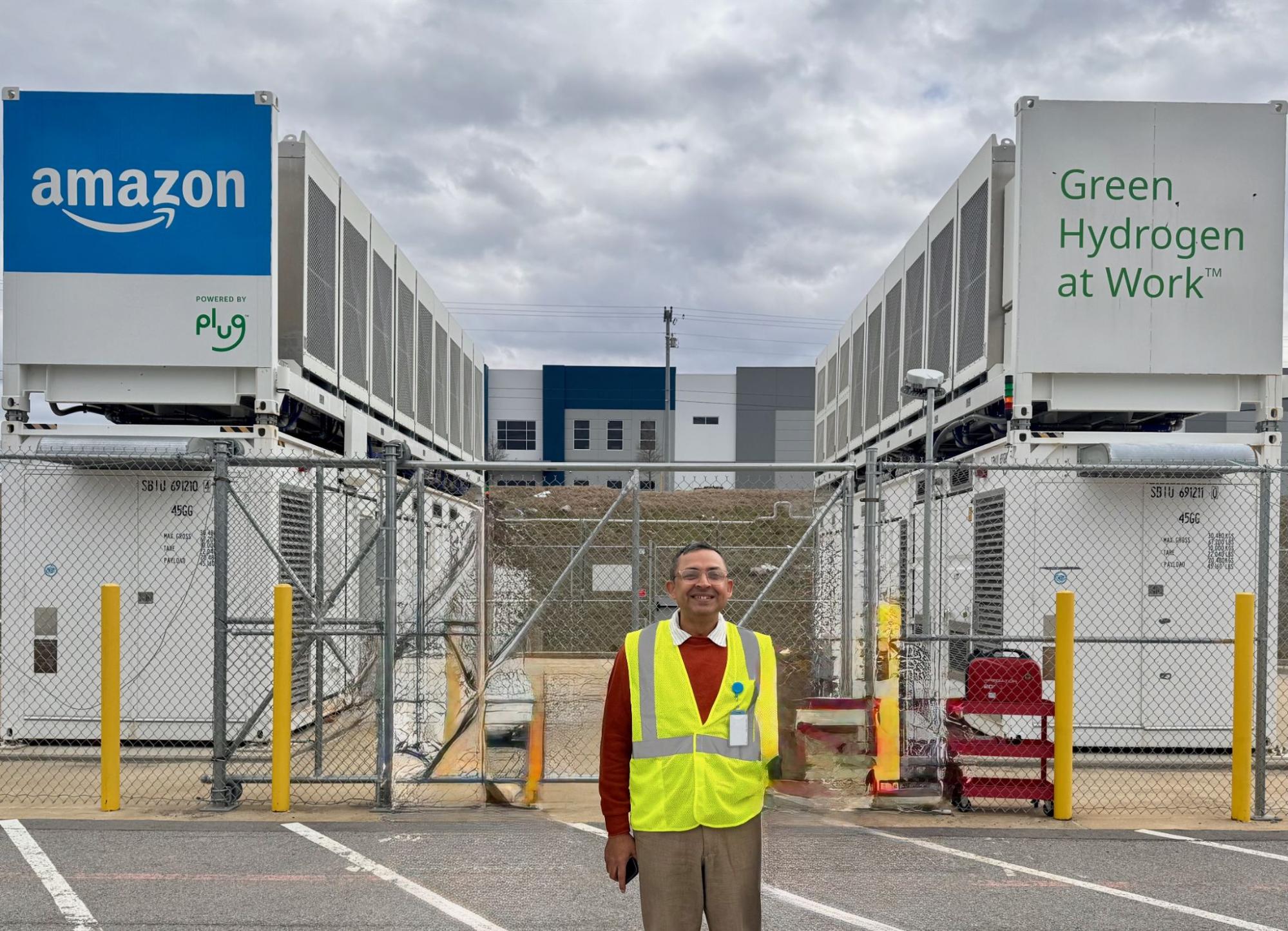
When it comes to energy, the US is power hungry. As data centers and AI use increase, it is estimated that energy use might triple by the start of the next decade. Recent data from the US Energy Information Administration shows how energy usage rates in the past five years are 17 times that of the two decades previous.
Subash Chandra, a leader in the use of energy-related technology in business operations, works closely with utility companies as part of his position at Amazon, and says it will only go higher. “The amount of energy we generated in the last 80 years is going to be the same as the amount we need in the next 10,” he says, “And relying solely on non-renewable energy sources for any of our energy needs is not feasible.”
“The solution,” Chandra explains, “is clean energy.”
Clean and renewable energy has been adapted for commercial, industrial, and residential use in many ways. One method heralds the future of transportation: Electric Vehicles (EV). It is a technology Chandra has extensively improved and advanced over the course of his career, and is continuing to do so as part of Amazon’s Energy team.
Amazon’s Green Vehicles
One part of the e-commerce company’s impressive climate pledge involves rolling out electric delivery vans. At 35 thousand vehicles and counting, Amazon’s electrification goal also focuses on developing the necessary infrastructure to support green energy fleet deployments across North America.
As the technical leader of the Energy team, Chandra has played a key role in accelerating this rollout by mitigating many unforeseen challenges. His work in energy management and design optimization helps maximize energy usage.
“Using EVs is a two-pronged approach,” Chandra says, “Reducing power demand, while also optimizing energy consumption. Trying to achieve more uses out of the same amount of power.”
Generation and Storage
The generation and storage of clean energy is a subset of technology that has great potential to evolve exponentially in the near future. So much so that it is part of a list of “advanced technologies that are potentially significant to U.S. national security”, and thus could “expand economic prosperity and opportunity” of the country.
When it comes to EVs, batteries are the main method of storage.
“The idea is this,” Chandra explains, “when energy grid demand is low, we use grid power to charge and store energy in batteries. When demand is high, those charged batteries are used as the power source. It’s not just about reduced energy costs, but managing energy usage efficiently instead of relying on overused and stressed grids.”
This method, which Chandra helped implement, is called ‘asynchronous charging’. It aims to optimize energy usage and obtain uninterrupted power availability. “When you manage energy usage in this way, the requirement to generate energy goes down,” he explains.
Chandra also guided the cloud-based management of individual battery charging, which ensures energy usage stays below a predetermined amount based on contracts with energy suppliers. These two methods are part of a wider multi-pronged approach that Chandra is working on to manage power constraints that have been implemented at Amazon.
“It definitely has potential to become an industry-wide application,” Chandra says, “As are microgrids, especially at locations where utility power is inadequate to meet demand. I’ve even developed a decision matrix that quantitatively evaluates the feasibility and employability of microgrids.”
Microgrids, which are hailed for their resiliency and ability to “operate autonomously”, are the subject of a government program to “modernize America’s power grid” in the face of natural disasters and the climate crisis. Part of its reliability comes from battery energy storage.
Chandra goes on to describe another offshoot of this method of storage: bi-directional meters that can be used to transfer unused energy back to the grid when it is overly stressed. “This method, too, can become a commercially viable energy solution in the near future.”
Lithium Litheness
Another path this technology is taking is the optimization of the battery itself. Lithium batteries are well known for having a higher energy capacity for a relatively lower volume. Lithium batteries also tend to be more malleable in terms of design.
“They can be thin, curved, or whatever form you need them to be,” Chandra says, “Compare this to other batteries, which need a specific shape to function.”
It might be this excess of potential that Lithium batteries are a target technology of the US Department of Energy to support “long-term U.S. economic competitiveness” in the international market.
Chandra explains how his work is directly involved in developing lithium batteries. “We work with vehicular manufacturers, collecting data like usage patterns,” he says, “We support investigation and improvements in the technology. It’s always exciting to see the direction of its development.”
Pioneers of Change
It’s not just technology that is impacted by Chandra’s work at Amazon, but the entire field in which they are used. When one of the biggest hurdles to EV vehicle adoption is the cost of infrastructure, the initiation of its use by big companies and institutions allows others in the ecosystem to benefit as well.
“What I do is like a catalyst for a lot of activities that spur growth,” Chandra says, “I know policy and regulations are developing to support smaller companies and EV users. I see utility companies adapting their approach to energy efficiency. Even safety and fire marshals are developing strategies for anything that might crop up.”
These adjacent activities build a healthier and permanent infrastructure for EV and clean battery technology, which can only spell good things for the future of the US economy.
Wide-scale Impacts
Supply chain networks are the backbone of our economy. And the US has a large supply chain network that depends a lot on vehicular mobility. The fact that EV technology can significantly lower costs, while making the movement of goods more efficient, marks EVs’ place in the next stage of supply chain management and economic growth.
“It helps that everyone is talking about EVs now,” Chandra says, “And that’s how consumption patterns of technology are defined. It’s even more thrilling to think about how EVs are still in the nascent stages.”
Indeed, the potential for this technology cannot be understated. Its impacts on health, safety, and clean energy are known. But as our society’s energy consumption grows, EVs impacts on other technologies and fields will become even more important.
“It’s not like I have a crystal ball that will tell me where this technology will go,” Chandra says with a laugh, “Currently, my focus is on leading the development of that supporting environment for future growth. Because right now, we can lay the foundation for the next stage. And I know allowing EVs to reach their full potential will only benefit us all.”

Johannah Lopez is a versatile professional who seamlessly navigates two worlds. By day, she excels as a SaaS freelance writer, crafting informative and persuasive content for tech companies. By night, she showcases her vibrant personality and customer service skills as a part-time bartender. Johannah's ability to blend her writing expertise with her social finesse makes her a well-rounded and engaging storyteller in any setting.