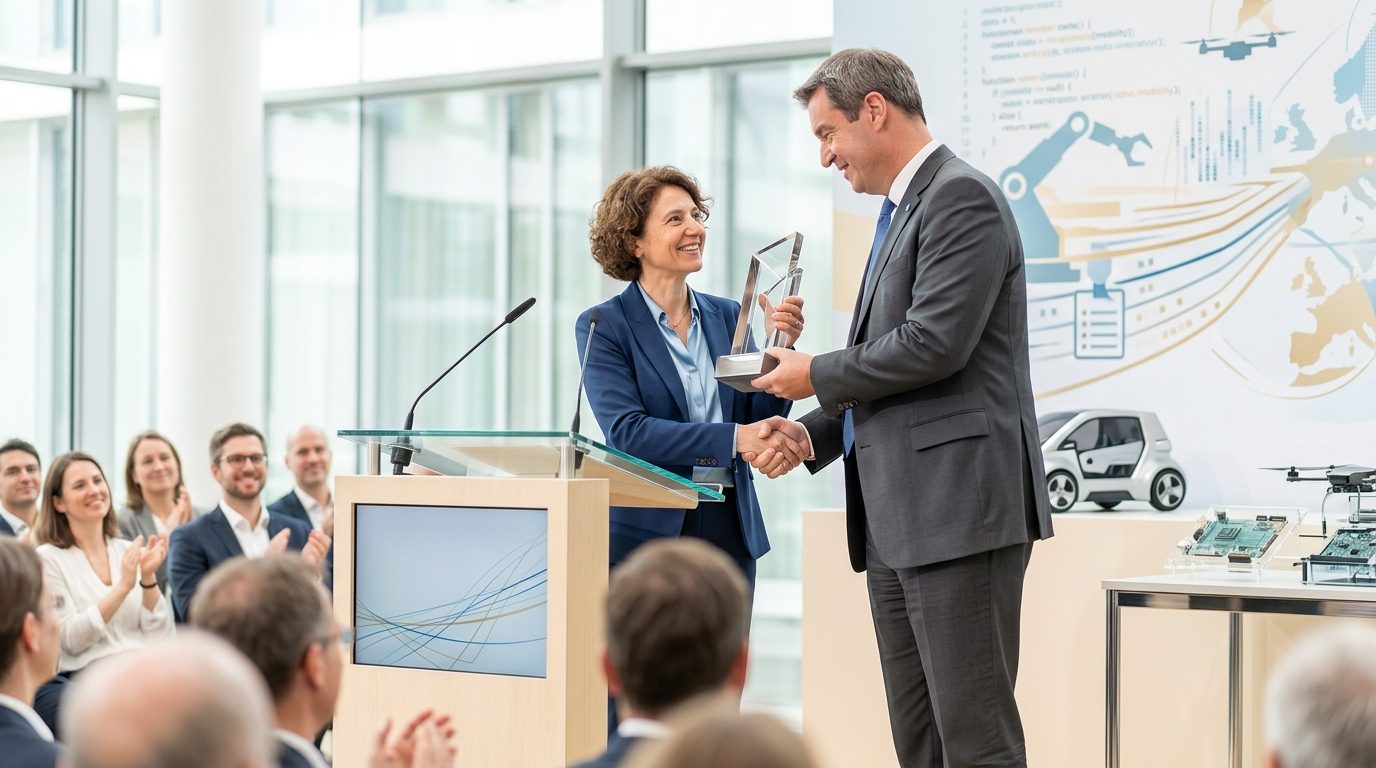
MIT professor Daniela Rus has received the Bavarian Minister-President’s 2026 High-Tech Prize for research spanning robotics, autonomous mobility, and artificial intelligence.
The award recognizes projects involving self-organizing robot collectives, soft robotics, autonomous transportation, and brain-inspired AI. Together, these fields seek to make machines more adaptable, cooperative, and useful in complex settings.
Rus is director of MIT’s Computer Science and Artificial Intelligence Laboratory, known as CSAIL. Her selection also highlights the growing international importance of research that connects computer science with machines operating in the physical environment.
Research Across Several Technical Fields
Rus’s work covers several areas that are often studied separately. Each addresses a different limit in how robots and intelligent systems operate.
- Self-organizing collectives examine how groups of robots can coordinate their actions.
- Soft robotics uses flexible materials and structures rather than only rigid mechanical parts.
- Autonomous mobility focuses on systems that can navigate with reduced human control.
- Brain-inspired AI draws ideas from biological intelligence to improve computation and learning.
Self-organizing robots could support tasks that are difficult for one machine to complete alone. A group may divide work, respond to local conditions, or reorganize when one unit fails.
Soft robots address a different problem. Traditional robots often rely on stiff frames and precise movements. Flexible designs may interact more safely with people, delicate objects, or uneven environments.
Autonomous mobility connects sensing, planning, and physical control. Progress depends not only on software accuracy, but also on reliable decisions under uncertain and changing conditions.
Recognition for Connected Research
The 2026 prize places these projects under one award rather than treating them as isolated achievements. That approach reflects a wider shift in robotics research.
Modern autonomous systems must combine several abilities. They need to sense their surroundings, make decisions, coordinate movement, and adapt when conditions change. Materials and mechanical design can be as important as algorithms.
Rus’s leadership role at CSAIL adds institutional weight to the honor. The MIT laboratory conducts research across artificial intelligence, robotics, computing systems, and related disciplines. Its work often links theoretical study with practical machines and software.
The Bavarian recognition also shows how regional technology policy can have an international reach. Bavaria has a major industrial base, including automotive, engineering, and manufacturing companies. Research in mobility and robotics has direct relevance to those sectors.
Practical Promise and Open Questions
The fields cited by the prize could affect transportation, health care, manufacturing, logistics, and emergency response. Cooperative robots may assist with large or hazardous tasks. Soft machines may offer safer forms of physical assistance. Autonomous systems may improve transport and industrial operations.
Yet major challenges remain. Robot collectives require dependable communication and coordination. Soft systems can be harder to model and control. Autonomous mobility must handle rare hazards, unclear signals, and unpredictable human behavior.
Brain-inspired AI also requires careful assessment. Biological ideas can guide new computing methods, but comparisons with human intelligence may create expectations that current systems cannot meet.
Safety, accountability, energy use, and public trust will shape how these technologies move from laboratories into daily use. Technical performance alone will not settle questions about responsibility when an autonomous system makes a harmful decision.
Rus’s award recognizes a body of research united by one broad goal: creating machines that can adapt more effectively to people and their surroundings. The next test will be whether these systems can achieve that goal safely, reliably, and at useful scale.

Senior Software Engineer with a passion for building practical, user-centric applications. He specializes in full-stack development with a strong focus on crafting elegant, performant interfaces and scalable backend solutions. With experience leading teams and delivering robust, end-to-end products, he thrives on solving complex problems through clean and efficient code.