Microchips keep shrinking, but physics is catching up fast. The current path—pushing light harder with ever pricier tools—has hit a wall of cost, speed, and physics. I believe the only way forward is to let materials do part of the work. That means steering chemistry, not only sculpting with light.
Why EUV Alone Is Hitting a Wall
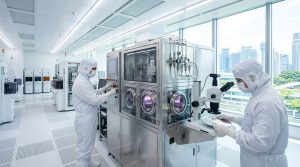
Extreme ultraviolet lithography (EUV) saved scaling once. It uses 13.5 nm light and machines that cost about $200 million. They run in a vacuum, bounce light off super mirrors, and rely on plasma so hot it rivals the sun. It is a controlled explosion, tuned to etch patterns a few atoms wide.
But even this marvel is running out of room. At these sizes, light arrives in single photons. That creates random variation, not smooth exposure. Raise the dose and you slow the machine. A day on the tool can cost over $150,000. **Speed drops, cost explodes, and yield risk rises.**
“If light can’t do it, then something else has to.”
The engineer’s point is clear. At 18A and 14A, high-NA EUV starts to struggle. **We can’t keep forcing a brush that is bigger than the feature.**
Directed Self-Assembly Is The Real Path
Directed Self-Assembly (DSA) flips the script. It uses block copolymers—molecules with two parts that dislike each other. Heat them, and they sort into neat, tiny patterns: lines, dots, cylinders. Left alone, that order is random. But guide it with a light-made template, and the material snaps into place where you want it.
“We need the materials to build themselves.”
Combine EUV for the guide with DSA for the fine detail, and you print features smaller than the light’s wavelength. **Chemistry tightens what lithography starts.** That means lower exposure dose, faster tools, and sharper features. This is how we move past the nanometer label into the angstrom class without breaking the bank.
The Strategic Split: Intel vs. The Pack
Here is the strategic rift that matters. Sony already uses DSA for image sensors, showing the flow can survive a real factory. But the hard test is logic chips at the leading edge. Intel plans to take that leap around 2027 with a 14A process. **It’s a bold bet on chemistry to finish the job that light starts.**
TSMC and Samsung are staying with brute-force EUV for logic. It costs more, but the process is predictable at massive scale. For them, predictability rules. I get it. Still, at 14A, the dose penalty for pure light grows harsh. **DSA could be the only way to keep cost and throughput in check.**
What Skeptics Get Right—and Wrong
DSA is not magic. Tiny impurities can wreck a chip. Integration is hard. Yields can dip. These are valid warnings. But they miss the bigger truth the engineer underscored.
- Light alone cannot set every line perfectly at 14A without painful doses.
- Photon shot noise will not go away.
- Throughput must rise, not fall, as nodes shrink.
Put simply, scaling needs a helper. **Let chemistry do the cleanup.** Light creates the map; materials snap to it. That hybrid model keeps performance gains alive without crushing economics.
My Take
I don’t see this as a nice-to-have. It’s a must. The choice is stark: cling to predictability and pay a growing tax, or take a controlled risk that restores speed and cost discipline. **I side with the controlled risk.** If Intel executes, it won’t just catch up; it will redraw the race. If it misses, the lesson will still be useful: the industry needs more chemistry in the stack, not less.
We should not wait. Foundries, suppliers, and research labs should invest in DSA materials, defect control, and metrology. Build pilot lines. Share process learning. Train a new class of “chem-litho” engineers. The longer we delay, the pricier each wafer gets and the slower progress becomes.
Moore’s Law won’t die from physics alone—it will die from our lack of nerve. Choose the path that scales.
Call to Action
Demand hybrid patterning from chipmakers. Support funding for polymer science and metrology. If you’re in the field, push for DSA trials on real product layers. If you lead a team, back cross-discipline training. The future of computing depends on chemistry stepping onto center stage.
Frequently Asked Questions
Q: What is Directed Self-Assembly in simple terms?
It’s a method where special polymers arrange themselves into tiny, regular patterns when heated. A light-made template guides them so the pattern forms in the right place.
Q: Why isn’t EUV lithography enough for future chips?
At angstrom scales, single-photon randomness and rising exposure doses slow tools and raise costs. You can push light harder, but the economics start to break.
Q: Has DSA been used in real manufacturing?
Yes. It is used in image sensor production. The challenge now is applying it to leading-edge logic, where tolerances are tighter and defect control is tougher.
Q: What risks come with adopting DSA for logic chips?
Material purity, integration complexity, and yield stability. Even small impurities can cause failures, so process control and metrology must be very strong.
Q: Who is betting on DSA at the cutting edge?
Intel plans to introduce DSA at its 14A node, targeting around 2027. Others are taking a wait-and-see approach, relying more on high-dose EUV for now.