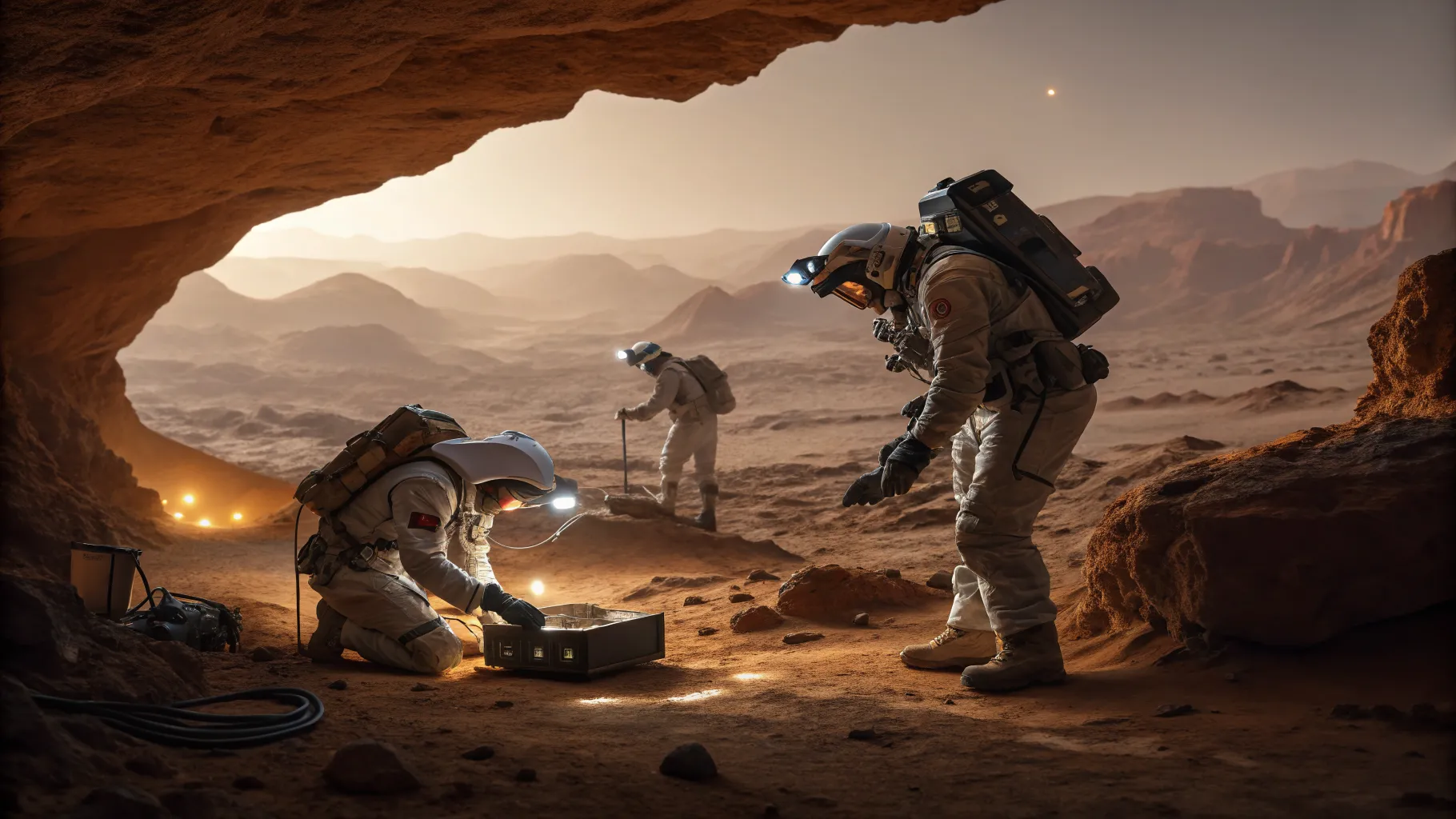
Scientists are turning their attention underground as they weigh the best places to look for life and to protect future crews on other worlds. From Martian lava tubes to ice-sealed pockets on Jupiter’s moon Europa, hidden interiors could hold the clues—and the shelter—space agencies have sought for decades.
The interest has sharpened as new missions approach key milestones. NASA’s Perseverance rover continues its work in Jezero Crater. Europa Clipper is set to survey Jupiter’s icy moon in the coming years. These efforts share a common thread: a push to understand environments that shield water, organics, and microbes from harsh radiation and extreme temperature swings.
From lava tubes on Mars to ice pockets on Europa, subterranean environments may offer the best chance of finding life—and living safely—beyond our planet.
Why Go Underground
Radiation is a major threat on airless or thin-atmosphere worlds. On Mars, surface radiation can be several hundred times higher than on Earth’s surface. Curiosity’s measurements suggest levels that would challenge both microbes and astronauts over time.
Rock and ice provide natural shielding. A few meters of basalt in a lava tube could cut radiation to far safer levels. On Europa, an ice shell many kilometers thick likely protects any subsurface brine pockets or the deep ocean from Jupiter’s intense radiation belts.
These protected zones also help preserve delicate chemistry. Organic molecules that would degrade in sunlight can persist in darkness. Water trapped in porous rock or frozen layers can remain stable for long periods, improving the odds that past or present biology left traces.
Mars Caves as Science Targets and Safe Rooms
Orbital cameras have mapped thousands of potential cave skylights on Mars. Images from NASA’s Mars Reconnaissance Orbiter hint at voids that could run for kilometers, some hundreds of meters wide. Lower gravity and thick basaltic flows make such giant tubes plausible.
For astrobiology, caves are attractive because they may host ice, salts, and protected sediments. For human missions, they offer natural shelters. Engineers study how vault-like roofs could temper daily temperature swings of more than 100 degrees Celsius and block harmful radiation.
Perseverance is not a cave explorer, but it is building the case for subsurface access. The rover is caching samples of fine-grained rocks and minerals that can trap organics and ancient water clues. Future drills or small robots could extend that work into skylights and shallow voids.
Europa’s Hidden Water and What Comes Next
Europa is a prime candidate for habitable conditions under its ice. Evidence from past flybys shows a fractured, active shell, hints of salt, and a likely global ocean. The question is where to look for near-term signs.
Scientists are now eyeing brine pockets and fractures within the upper ice. These features may cycle water and chemicals closer to the surface, where a spacecraft can sample them from orbit or during close passes.
Europa Clipper will carry ice-penetrating radar, spectrometers, and cameras to map these targets. The mission will not land, but it can identify “sweet spots” for later probes. ESA’s JUICE mission, launched in 2023, will add broader context in the Jovian system, including Ganymede, which also holds deep ice and water.
What the Data Suggest So Far
- Mars: Orbital surveys show many suspected cave skylights; Curiosity and Perseverance detect organics in surface rocks, though not proof of life.
- Europa: Past missions found surface chemistry and hints of plumes; new missions will test for near-surface brines and map ice thickness.
- Radiation: Rock or ice overburden greatly reduces exposure, aiding both biology and crew safety.
Risks, Limits, and Next Steps
Cave access is hard. Skylight edges can be unstable, and dust can foul equipment. On Europa, surface radiation and low gravity complicate operations. Even with radar and cameras, distinguishing water-rich zones from solid ice is challenging.
There is also a caution on interpretation. Organics are not life. Chemistry can mimic biosignatures, so cross-checked instruments and sample return are vital. That is why Mars Sample Return planning remains central, even as timelines shift.
Still, the strategy is clear. Focus on places that protect water and chemistry. Use radar to map interiors. Send agile robots, then consider drills or melts where the payoff justifies the risk.
The push underground reframes the search for life and plans for human travel. Lava tubes on Mars could offer both scientific targets and natural shelters. Ice pockets and fractures on Europa may expose ocean chemistry within reach of a spacecraft. As new missions deliver high-resolution maps and fresh data, the most promising sites will come into focus. The next wave of exploration will likely start at the edges of skylights and along Europa’s fractured plains, where hidden worlds may be closest to the surface.

A seasoned technology executive with a proven record of developing and executing innovative strategies to scale high-growth SaaS platforms and enterprise solutions. As a hands-on CTO and systems architect, he combines technical excellence with visionary leadership to drive organizational success.