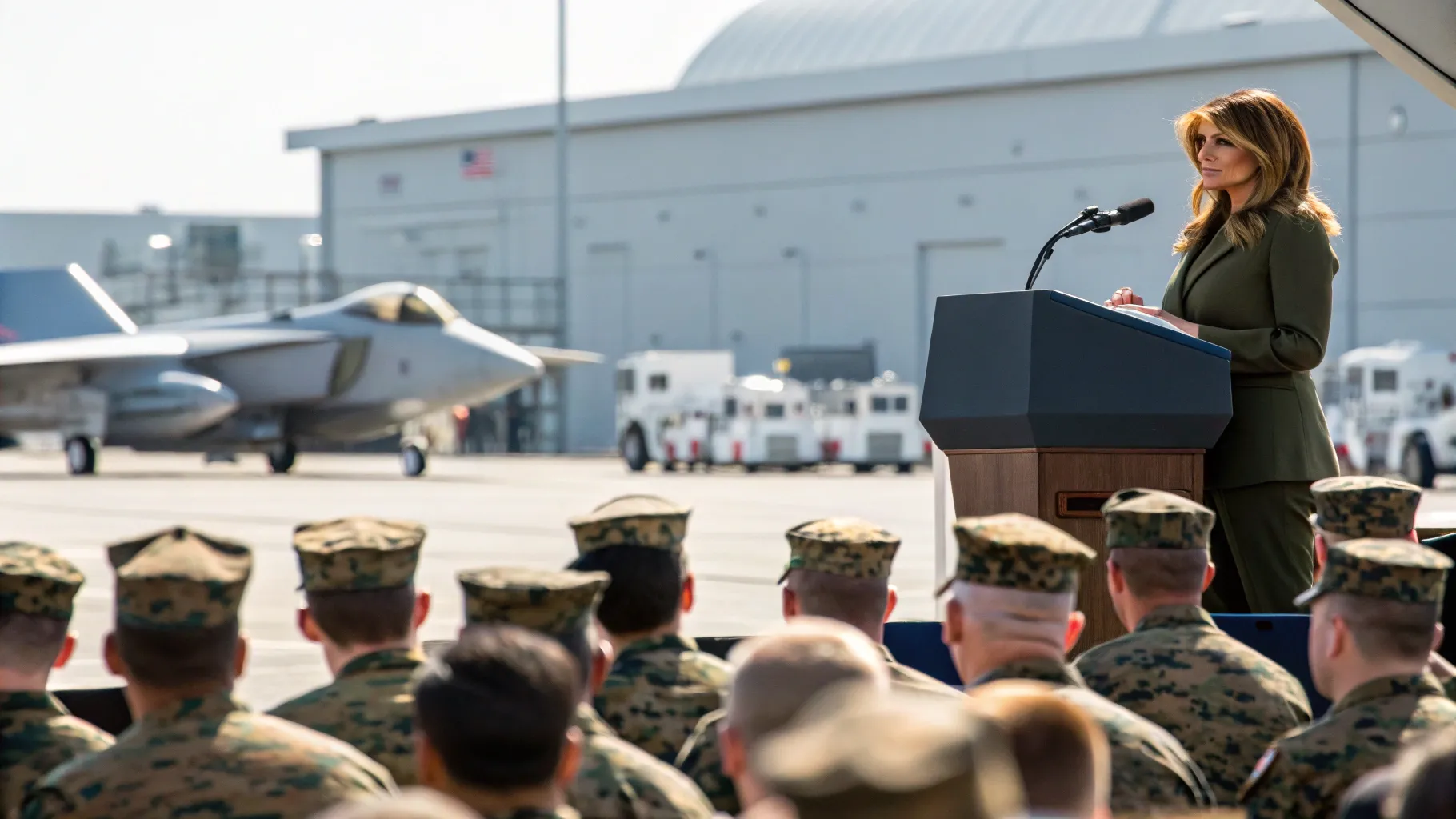
First Lady Melania Trump highlighted the growing role of artificial intelligence in U.S. defense during remarks at Marine Corps Air Station New River on Wednesday. Speaking to Marines and their families, she addressed how AI tools are changing planning, logistics, and combat support, drawing attention to an issue now central to military readiness.
First Lady Melania Trump shared how artificial intelligence (AI) is reshaping modern American warfare in remarks at Marine Corps Air Station New River on Wednesday. (Credit: Pool)
Her appearance came as the Pentagon continues to integrate machine learning into operations, while debating limits on autonomy and human control. The event offered a rare view of the topic through a public figure, rather than a senior defense official, underscoring how the conversation has moved from technical forums to the national stage.
Why AI Matters to the Military
The Department of Defense has pursued AI for years to speed analysis and improve decision-making. Programs such as Project Maven, launched in 2017, brought machine learning to imagery processing. In 2022, the Pentagon consolidated digital and AI efforts under the Chief Digital and Artificial Intelligence Office to accelerate real-world use.
AI touches every part of the enterprise. Commanders use algorithms to triage drone feeds. Planners apply predictive tools to supply chains. Cyber teams rely on automated detection to spot threats in crowded networks. The promise is faster insight with fewer delays.
The Marine Corps has focused on small, distributed units that can operate with limited support. AI-enabled sensing, navigation, and logistics can help those units move and communicate under pressure. That is one reason the topic resonates at a Marine aviation hub like New River.
Balancing Speed and Control
Speed is the main draw. AI can process data much faster than human teams and surface patterns they might miss. But military leaders also stress human judgment. The Pentagon adopted AI ethical principles in 2020, requiring responsible design, testing, and oversight. Those principles emphasize that commanders must remain accountable for decisions.
In practice, that means rigorous training data, transparent testing, and clear “human-in-the-loop” policies for sensitive functions. It also means planning for failure. Leaders treat AI outputs as inputs to decisions, not orders to follow.
- Faster analysis can shorten targeting and rescue timelines.
- Automation helps crews manage maintenance and flight safety.
- Safeguards and audits are needed to catch bias and errors.
Voices From the Field
Service members often describe AI as another tool, not a silver bullet. Aviators want predictive maintenance that works in austere settings. Intelligence Marines want systems that explain why an alert fired. Cyber defenders want automation that reduces noise but flags true threats with context.
Policy advocates urge strict limits on lethal autonomy, warning that machines should not decide to use force. Defense planners reply that current U.S. policy keeps humans responsible, and that validation and verification are essential before deployment. Both sides agree transparency and testing matter.
What the Moment Signals
The First Lady’s focus framed AI not only as a technical issue but a family one. Faster decisions and better logistics can reduce risk for service members. At the same time, families want assurance that safeguards are real, not slogans. Bringing the subject to a military base audience reflects public interest in how technology shapes safety and service.
It also points to a broader shift. AI discussions now extend beyond labs and think tanks to everyday stakeholders: pilots, maintainers, spouses, and local communities near bases. That broader audience can press for clear rules of use and steady oversight.
What Comes Next
Experts expect near-term gains in three areas: predictive maintenance across aviation fleets, rapid sensor fusion for dispersed units, and cyber defense automation. Each offers measurable benefits, such as fewer unscheduled repairs and faster alert triage. The challenge is scaling tools while guarding against bias, brittleness, and adversary deception.
Congress and the Pentagon will likely continue hearings, audits, and independent test campaigns. The Marine Corps, for its part, will push for systems that work in contested environments with limited bandwidth. Clear metrics—uptime, error rates, and response times—will matter more than hype.
Wednesday’s remarks placed a national spotlight on these practical questions. The message was that AI now sits at the center of U.S. defense planning, but people remain the core. The coming year will test how well the services turn that message into training, policy, and reliable tools in the field.
Related Articles
- US Military Accelerates Move Into AI
- AI Shapes Ukraine-Russia Battlefield Risks
- OpenAI awarded $200 million U.S. military contract

A seasoned technology executive with a proven record of developing and executing innovative strategies to scale high-growth SaaS platforms and enterprise solutions. As a hands-on CTO and systems architect, he combines technical excellence with visionary leadership to drive organizational success.