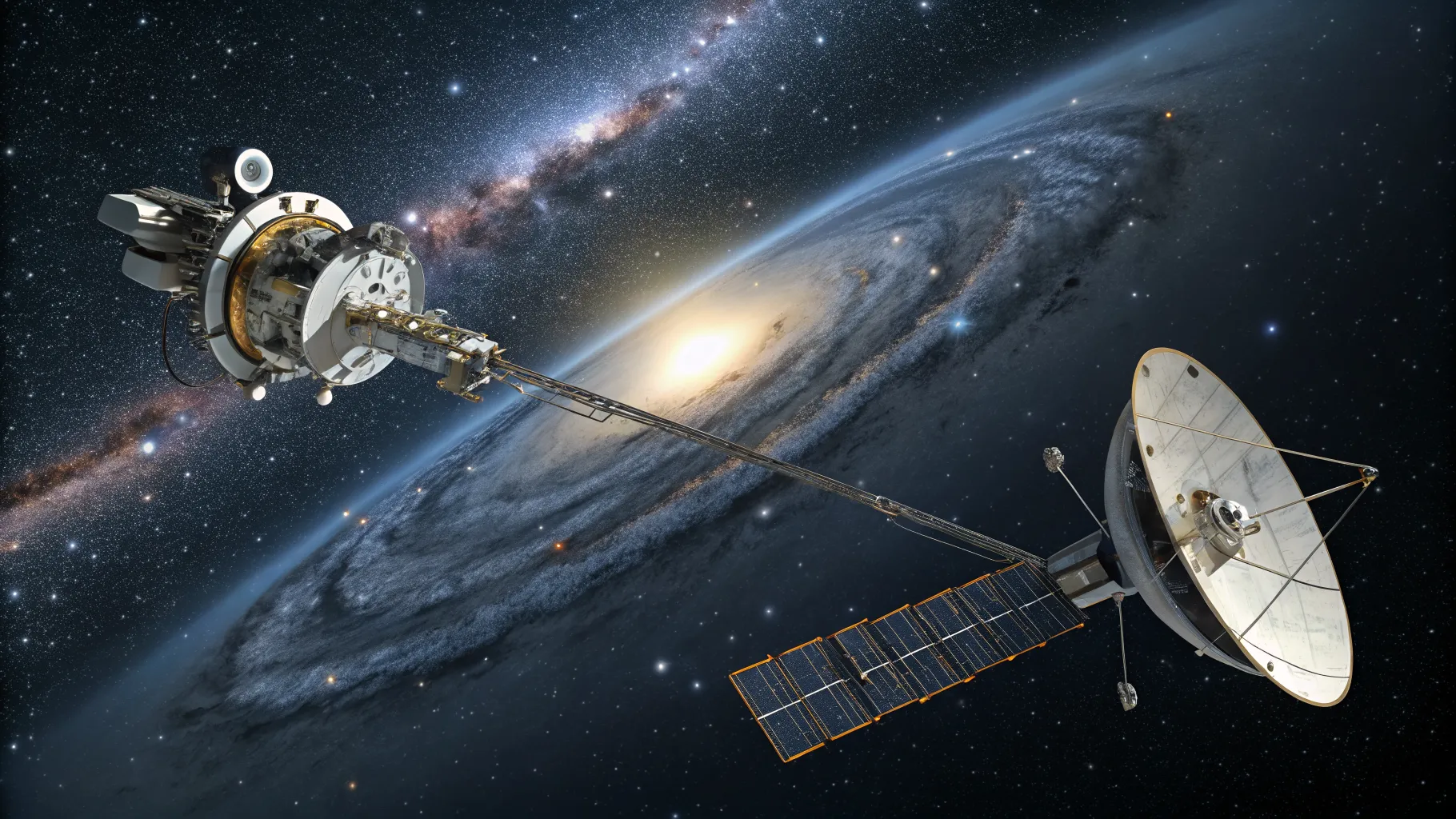
Do spacecraft know how fast they are going? The short answer is tricky, and it has sparked a fresh look at how navigation really works beyond Earth.
A recent claim that spacecraft lack a direct speedometer set off a wave of questions from readers and viewers. Engineers say that is broadly true. Spacecraft cannot sense “absolute” speed. Instead, they compute speed using physics, careful timing, and reference points like stars, Earth, or GPS satellites. The approach works in low orbit and deep space, but it depends on where the craft is and what tools it carries.
Why “Speed” Is Tricky In Space
“Weirdly, spaceships have no direct way to gauge their own speed. Luckily, we can use some physics tricks to figure it out.”
There is no universal speed reference in space. Speed is always relative to something else, such as Earth, the Sun, or a nearby asteroid. That is a basic point in physics. A car can turn its wheels and read road speed. A spacecraft has no road.
This is not a new problem. Apollo crews used sextants to sight stars and the horizon to refine their path. Today’s missions use sensors and ground support to do the same job with far greater precision.
The Tools Engineers Use
Modern spacecraft blend several methods. Each has strengths and gaps. Together, they give a reliable picture of motion and position.
- Inertial measurement units: Gyros and accelerometers measure rotation and acceleration. Onboard computers integrate those readings over time. Drift builds up, so they need updates.
- Star trackers and optical navigation: Cameras lock onto star patterns to fix the craft’s attitude. By imaging planets, moons, or landmarks, software can estimate both position and speed.
- Radio Doppler and ranging: Ground stations, such as NASA’s Deep Space Network, send radio signals and read the shift on return. Line‑of‑sight speed can be measured to millimeters per second.
- GNSS in low Earth orbit: Many satellites use GPS or multi‑GNSS receivers. They compute velocity to within centimeters per second when signals are strong and geometry is good.
- Pulsar timing experiments: Spacecraft can time the flashes of distant pulsars as natural beacons. The method is still experimental but promising for deep space autonomy.
Each system fills a gap. In deep space, there is no GPS, so missions lean on radio tracking and optical fixes. Near Earth, GNSS reduces the workload on ground teams. In all cases, inertial sensors bridge the time between updates.
What “Speed” Means Depends On The Frame
Mission teams define speed relative to a chosen frame. Low‑orbit satellites care about speed relative to Earth’s center. Interplanetary craft often use the Sun as the frame. During landings, speed relative to the target surface matters most.
That choice affects fuel use and safety margins. A Mars lander might show a small speed relative to the Sun but a high speed relative to Mars. Guidance software tracks the right measure for each phase.
Accuracy, Limits, and Risks
Doppler tracking is very precise along the line of sight but less so sideways. Optical navigation can solve that by providing angle data. Inertial units drift over hours to days, which can grow into large errors if left alone. Teams schedule frequent updates to keep the solution tight.
For crewed flight, redundancy is key. Multiple sensors cross‑check each other. That reduces the chance of a single bad reading leading to a wrong burn. For small probes with tight budgets, teams trade some onboard autonomy for more ground support.
Why It Matters Now
As more missions head to the Moon, asteroids, and Mars, precise speed knowledge saves fuel and time. It also reduces risk during critical events like orbit insertions and landings. Commercial firms building tugs and stations in low Earth orbit rely on GNSS and lidar to dock safely.
Work is moving ahead on better space‑rated GPS receivers, optical navigation with AI, and wider use of X‑band and Ka‑band radio. Together, these advances aim to cut dependence on Earth while keeping accuracy high.
Spacecraft do not have a simple speedometer, and they do not need one. By combining sensors, math, and smart reference frames, they get speed when it counts. The next wave of missions will test more autonomous methods, from pulsar timing to vision‑based landing. Watch for deeper use of optical navigation around the Moon and more precise Doppler tracking on Mars trips, as agencies and companies push for safer, faster travel across the Solar System.

Rashan is a seasoned technology journalist and visionary leader serving as the Editor-in-Chief of DevX.com, a leading online publication focused on software development, programming languages, and emerging technologies. With his deep expertise in the tech industry and her passion for empowering developers, Rashan has transformed DevX.com into a vibrant hub of knowledge and innovation. Reach out to Rashan at [email protected]