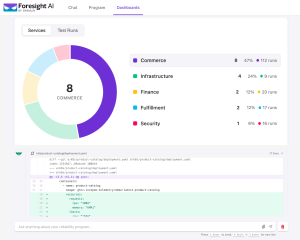
The pager goes off, dashboards are red, and production symptoms point to the same service. Latency spikes after a deploy. Error rates climb in one API. A database graph looks ugly enough to convict on sight. But production incidents rarely respect the neat boundaries in your topology diagram. The thing that is visibly failing is often just the first component honest enough to complain.
Senior engineers learn this the hard way. The most expensive incidents are not always caused by the loudest alarms. They are caused by hidden coupling, shifted load patterns, stale assumptions, and feedback loops that make one subsystem look guilty while another quietly created the conditions. If you have ever rolled back the obvious change, watched nothing improve, and then spent the next two hours tracing a failure sideways through caches, queues, retries, and control planes, these signals will feel familiar.
1. The blast radius ignores the service boundary
When the production symptoms point cleanly to one service but the user impact cuts across unrelated workflows, your root cause is probably elsewhere. A genuine defect inside a single API tends to fail along functional lines. A dependency problem, by contrast, creates strangely distributed damage. You see checkout issues, search timeouts, and background job lag at the same time, even though only one service looks unhealthy. That pattern usually means the visible failure sits on a shared path such as identity, service discovery, a message broker, a rate limiter, or a network policy change.
This matters because service-level ownership can distort incident thinking. Teams naturally start where their alerts are firing. In practice, the better question is not which service is red, but which dependency graph could make multiple healthy-looking systems degrade in different ways. I have seen a cache cluster with rising eviction pressure make one API look broken, while five other services only showed mild latency drift. The API took the blame because it had the strictest timeout budget.
2. Retries are rising faster than hard failures
A low error rate can be deeply misleading when retry behavior is masking the real problem. If request success remains acceptable but retry volume, queue depth, or connection churn climbs sharply, you may be looking at an upstream saturation issue rather than a defect in the responding service. Systems under stress often fail soft before they fail hard. Tail latency stretches, connection pools thrash, and clients quietly multiply traffic in the name of resilience.
That creates one of the most common incident misreads in distributed systems. Production symptoms appear in the downstream service that finally starts timing out, but the trigger lives in the layer that induced retry amplification. Amazon’s published guidance on timeout and retry discipline made this lesson mainstream for a reason: retries are selfish, and under the wrong conditions they turn a partial impairment into a system-wide event. For senior engineers, the key signal is not just “are requests failing?” but “is the system paying more per successful request than it paid an hour ago?”
3. The first anomaly shows up in saturation, not errors
When CPU steal, disk wait, thread pool exhaustion, or GC pause time moves before application errors do, the visible production symptoms are usually downstream of resource contention. Error rates tell you when the system has already crossed a user-visible threshold. Saturation tells you where the underlying physics started changing. A service that begins dropping requests at 2:17 p.m. may only be the canary for a node group that started fighting noisy-neighbor effects at 1:52.
This is why strong operators watch the four golden signals, not just correctness metrics. In many real incidents, utilization and queuing move first, latency follows, and errors show up last. Google’s SRE work on cascading failures and overload shaped this mindset, but it still gets lost in teams that over-index on exception dashboards. If the resource graph bends before the application graph does, trust the resource graph. It is often closer to the cause than the code throwing the exception.
4. A rollback changes the graph, but not the outcome
A rollback that clearly removes the production symptoms without materially restoring user experience is a strong sign that the deploy was correlated with the incident, not causal. This happens more than teams like to admit. A new release may alter traffic shape, cache keys, query distribution, or concurrency patterns just enough to expose an existing weak point. Once that weak point tips over, undoing the release does not necessarily relieve the underlying pressure.
You see this in systems with fragile steady-state assumptions. A deployment warms caches differently, triggers backfills, or briefly increases pod churn. That small shift is enough to surface a hidden limit in the database, broker, or control plane. Rollback makes everyone feel safer because it reduces recent uncertainty, but it can also lock the room onto the wrong narrative. The pragmatic move is to treat rollback as a containment action, not proof of cause.
5. The component that looks broken is actually the one enforcing a budget
Sometimes the loudest subsystem is the one behaving correctly. API gateways return 503s because upstream budgets are gone. Circuit breakers open because they are supposed to. Schedulers refuse work because concurrency caps are protecting the cluster. In these cases, the visible symptom points at the component applying policy, not the one consuming capacity irresponsibly or degrading the shared dependency underneath.
This distinction matters because policy-enforcing layers are optimized to be legible. They emit crisp errors and clear metrics. The true source may be murkier: a fan-out path that doubled request volume, a background reindexing job that ignored priority lanes, or a consumer group that stopped committing offsets and quietly inflated lag. I have seen teams spend an hour debugging an ingress tier that was simply the first place the platform converted overload into an explicit signal. The ingress was not broken. It was honest.
6. Correlation appears after a traffic shape change, not a code change
Production failures often hitch a ride on shifts in cardinality, burstiness, and skew. A system can tolerate average load for months and still collapse when tenant mix changes, one customer runs an unusual workload, or an innocuous feature causes wider cache miss distribution. If production symptoms appear after a promo event, data backfill, regional failover, or cron alignment, but everyone is still staring at the latest merge, you are probably hunting in the wrong place.
This is where experienced engineers separate throughput from load shape. Ten thousand requests per second with stable keys is not the same system as ten thousand requests per second with unbounded key churn or synchronized fan-out. Netflix’s engineering work on resilience and chaos testing helped popularize the idea that failure comes from interaction effects, not just component defects. For diagnosis, the useful question is whether the system was asked to behave differently, even if nominal load looked unchanged.
A quick check that often pays off:
- Top N hot keys changed
- Request fan-out increased
- Batch jobs aligned unintentionally
- Tenant distribution skewed
- Cache miss ratio climbed first
7. Only one observability layer tells a consistent story
When logs blame one service, traces implicate another, and infrastructure metrics hint at a third, the temptation is to trust the most detailed tool. Resist that. Inconsistent observability is itself a signal. It often means you are crossing an abstraction boundary where instrumentation quality changes or context propagation breaks. The gap between tools can reveal the fault line. Missing spans, cardinality caps, sampled-out retries, or lagging metrics pipelines create blind spots that make production symptoms look local when the cause is cross-cutting.
Senior engineers should treat observability disagreements as architecture data. A message queue may not preserve correlation IDs cleanly. An async worker pool may report success before side effects complete. A managed service may expose coarse metrics that flatten burst behavior. The issue is not only that your telemetry is incomplete. It is the incompleteness often clusters around the very seams where incidents originate. If one layer tells a beautifully coherent story while the others look noisy, there is a good chance you are seeing the polished edge of the problem, not its center.
8. The fix that helps most is load reduction, not code correction
One of the clearest signs you have misidentified the problem location is when the best mitigation has nothing to do with changing the suspected component. Disabling a noncritical feature, lowering retry ceilings, shedding background work, extending cache TTLs, or rate-limiting one client cohort stabilizes the system faster than patching the service that appears broken. That usually means the visible fault was a victim of systemic pressure.
This is one reason incident response and root cause analysis should stay mentally separate. During the event, the winning move is often to reduce demand on shared resources and restore margin. After the event, you can trace the interaction that created the pressure in the first place. A real pattern from Kubernetes-heavy environments is that the apparent application issue disappears once control-plane churn, autoscaling oscillation, or DNS pressure is reduced. The code never changed. The system regained headroom, and the symptom vanished with it.
The hardest production incidents are the ones where the system tells the truth, just not the whole truth. Production symptoms still matter, but they are often reporting the nearest pressure boundary rather than the original fault. The more distributed your architecture becomes, the more you need to diagnose along dependency paths, traffic shape, and control feedback loops, not just red boxes on a dashboard. Good operators do not ignore the obvious symptom. They just know better than to stop there.
Related Articles
- Six Debugging Habits That Reduce Incident Resolution
- 7 Traits Of Engineers Who Fix Incidents Fast
- Debugging Trade-Offs Teams Ignore Too Late
- Seven Debugging Patterns That Expose Architecture

A seasoned technology executive with a proven record of developing and executing innovative strategies to scale high-growth SaaS platforms and enterprise solutions. As a hands-on CTO and systems architect, he combines technical excellence with visionary leadership to drive organizational success.