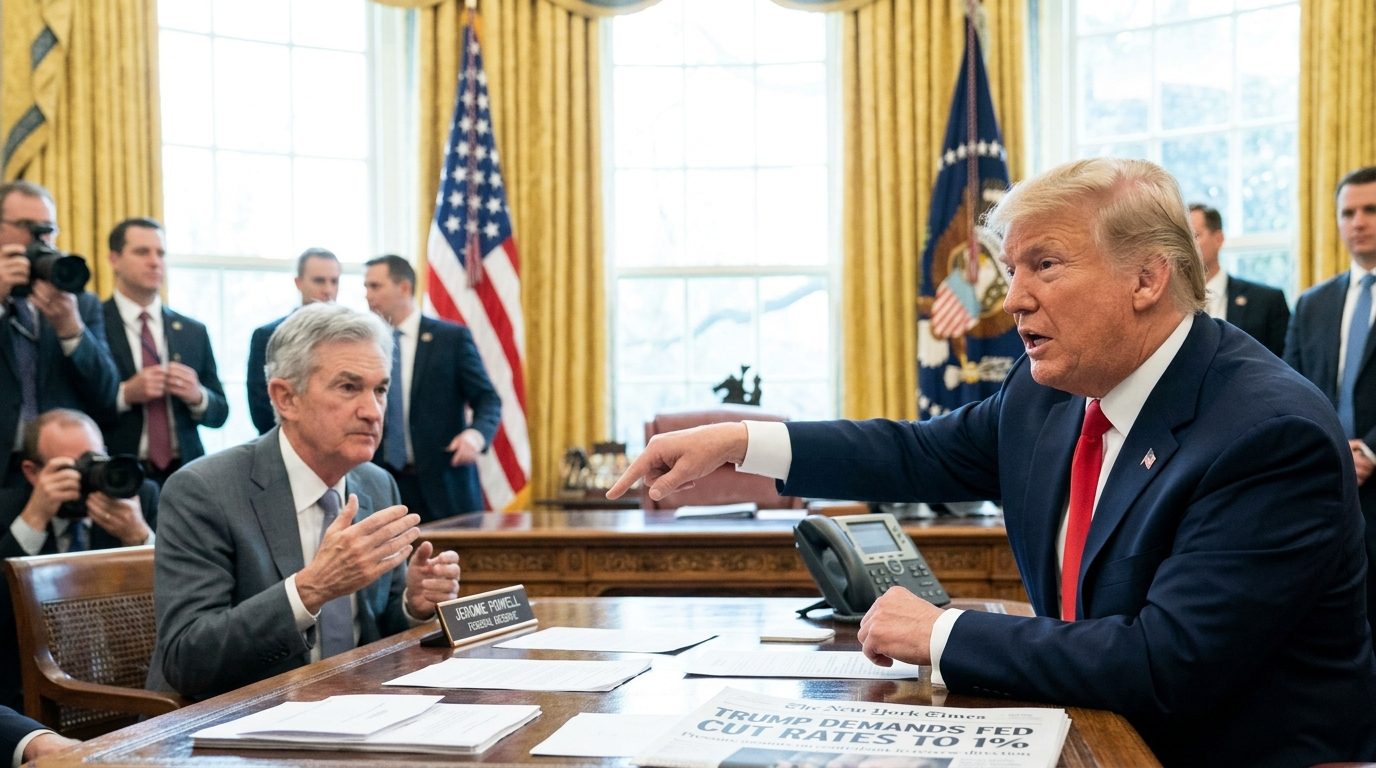
President Donald Trump demanded that the Federal Reserve lower interest rates to 1% or less, hours after the central bank announced its first increase since 2023.
The competing moves exposed a sharp disagreement over the direction of US monetary policy. Trump called for much cheaper borrowing, while the Fed chose tighter financial conditions. The size of the rate increase was not disclosed.
President Presses for Sharp Reversal
Trump issued a direct public demand following the Fed’s announcement.
The Federal Reserve should slash interest rates to 1% “or less,” Trump said.
Such a reduction would represent a major change in policy after a rate increase. Lower rates usually reduce borrowing costs for some households and companies. They may also support spending, hiring and investment.
However, rapid cuts can carry risks. Cheaper credit may add to price pressures if demand grows faster than the economy’s ability to supply goods and services.
Trump’s statement did not specify which interest rate he wanted reduced to 1%. Presidents often focus on the federal funds rate, which influences other borrowing costs across the economy.
Fed Increase Signals Different Priorities
The Fed’s first rate increase since 2023 suggests officials saw a reason to restrain economic activity or guard against inflation. The central bank’s stated reasons and vote were not provided.
Rate increases can affect several parts of the economy:
- Loans may become more expensive for consumers and businesses.
- Housing demand may weaken as financing costs rise.
- Savers may receive higher returns on some deposits.
- Economic growth may slow as borrowing declines.
These effects are not immediate or uniform. Mortgage rates, credit card charges and business loan costs also reflect market conditions and borrower risk.
Political Pressure Meets Fed Independence
The dispute also places renewed attention on the Federal Reserve’s independence. Congress created the central bank, but monetary policy decisions are designed to remain separate from daily White House control.
That structure allows Fed officials to make decisions based on economic conditions rather than election schedules. Presidents may still criticize policy or urge different action, but they do not directly set interest rates.
Supporters of lower rates may argue that expensive credit restricts housing, business expansion and job creation. Those favoring tighter policy may contend that controlling inflation protects household purchasing power and reduces the risk of larger corrections later.
Markets Await Further Signals
Investors and borrowers will now assess whether the increase begins a longer cycle or stands as a single adjustment. Future Fed decisions will likely depend on inflation, employment, consumer demand and broader financial conditions.
The key divide is clear. Trump wants an aggressive reduction to 1% or below, while the Fed has moved in the opposite direction. Upcoming economic reports and statements from central bank officials will show whether that policy gap grows or begins to narrow.

Rashan is a seasoned technology journalist and visionary leader serving as the Editor-in-Chief of DevX.com, a leading online publication focused on software development, programming languages, and emerging technologies. With his deep expertise in the tech industry and her passion for empowering developers, Rashan has transformed DevX.com into a vibrant hub of knowledge and innovation. Reach out to Rashan at [email protected]